Firm Responses to Tax Disincentives: Evidence from Denmark
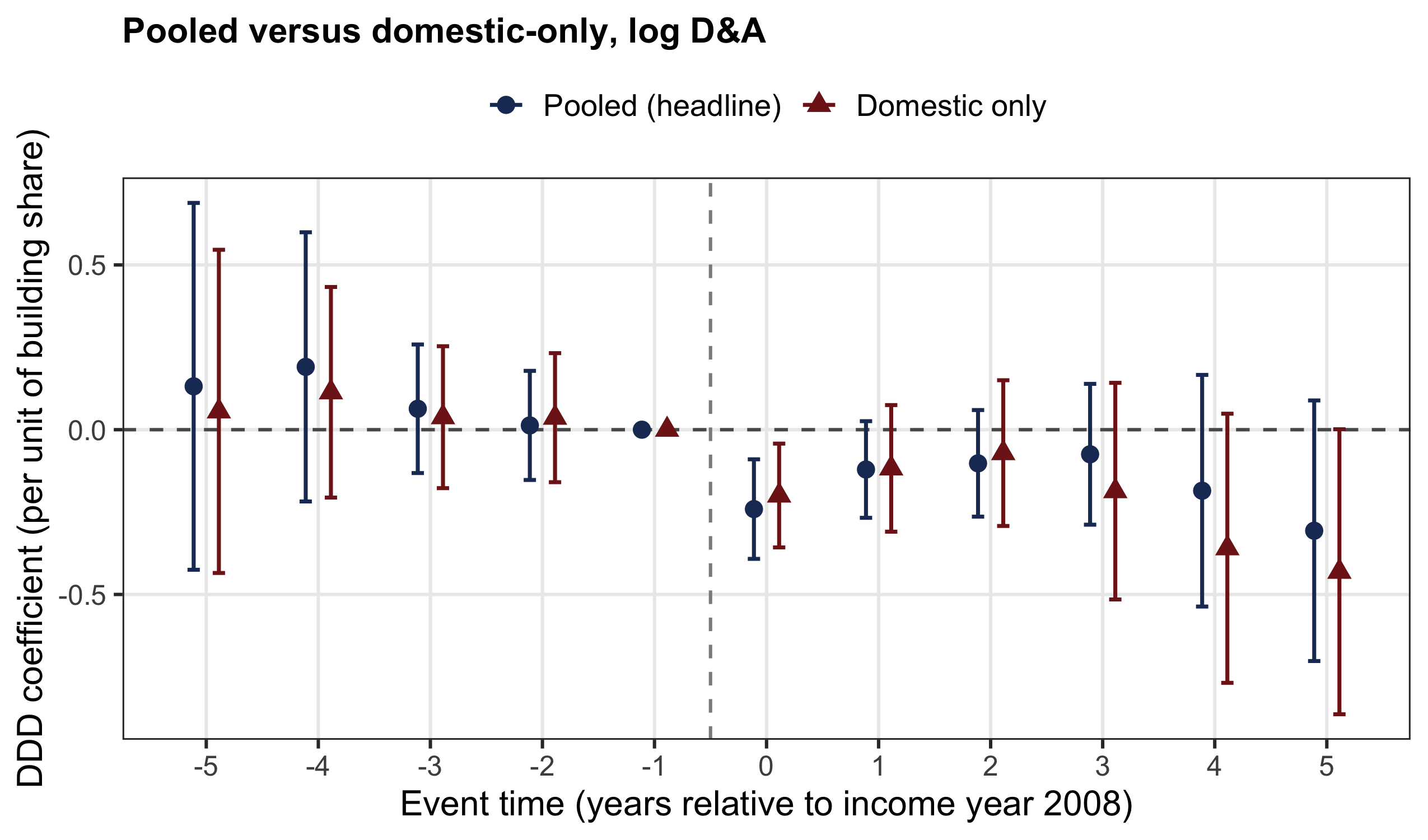
Examines firms’ responses to Denmark’s 2008 depreciation allowance reform using firm-level Orbis data and a triple difference-in-differences research design to identify its causal effects.
PhD Candidate in Economics
Department of Applied Economics
Erasmus School of Economics & Tinbergen Institute
Erasmus University Rotterdam

I’m a first-year PhD candidate in economics at the Erasmus School of Economics. My research interests lie broadly in public economics and industrial organisation, with a particular focus on corporate taxation, firm behaviour and policy evaluation.
Before starting my PhD, I worked as a research assistant at the Max Planck Institute for Tax Law and Public Finance. I hold a bachelor’s degree in economics from the University of Manchester and a master’s degree in quantitative economics from LMU Munich.
Examines firms’ responses to Denmark’s 2008 depreciation allowance reform using firm-level Orbis data and a triple difference-in-differences research design to identify its causal effects.
Using firm-level microdata from Statistics Netherlands (CBS), this study aims to identify the causal effects of the 2022 Dutch energy-support measure by exploiting its eligibility threshold as a source of quasi-experimental variation, while also examining the determinants of subsidy take-up as a secondary research objective.
Lecture: Economics of Strategy (Graduate level), Erasmus School of Economics
Erasmus School of Economics
hessels@ese.eur.nlErasmus School of Economics
pennings@ese.eur.nl